 English
 中文简体
中文简体 عربى
عربى Español

Switch on a chocolate fountain and, within about a minute, melted chocolate climbs a center column and falls back in a glossy curtain over every tier. The effect looks theatrical, but the machine is a simple circulation loop: a heated basin keeps the chocolate liquid, a motor-driven auger lifts it to the top, and gravity pulls it down over the tiers so it can start the trip again. Heat solves the flow problem, the auger solves the lifting problem, and gravity supplies the drama. Once you understand those three jobs, every practical question about running a fountain—why the curtain breaks into gaps, why chocolate stiffens halfway through a party, how much chocolate you actually need—can be answered before it turns into a problem.
The Three Parts That Make Chocolate Climb and Flow
Every home chocolate fountain, from the smallest two-tier mini to a large rental-grade unit, runs on the same three components working in sequence.
The heated basin
The basin is the wide bowl at the base, and it carries a heating element under or around its floor. Its job is temperature maintenance, not cooking. Chocolate does not melt efficiently inside a fountain: solid chocolate is too stiff for the auger to move, and slow direct heating scorches the layer touching the bowl. That is why reliable instructions always tell you to melt the chocolate first and pour it in. Once loaded, the basin holds the mass just above the point where cocoa butter stays fully liquid, so the chocolate remains smooth and pumpable for hours of serving.
The auger
Running up through the middle of the basin is a central cylinder holding an auger—a helical screw driven by a small motor in the base. When it turns, it behaves like a screw conveyor: chocolate enters at the bottom and rides the spiral upward, the same way an Archimedes screw lifts water. Because the auger sits inside the chocolate itself, it does a second job for free. It stirs the whole volume continuously, which keeps the temperature even and stops cocoa solids from settling against the floor of the basin.
The crown and the tiers
At the top of the column sits the crown, a dome that catches the rising chocolate and spreads it outward. From there the chocolate flows over a stack of downward-sloping tiers. Each tier receives a sheet so thin that it pulls slightly away from the surface, so guests see falling chocolate rather than a wet plate—that is the visual trick behind the curtain. From the lowest tier, the chocolate drops back into the basin and the circuit starts again. A complete loop takes only seconds, so the chocolate on your skewer has just been warmed, mixed, and delivered.
Why Chocolate Consistency Decides Whether the Fountain Works
Here is the conclusion worth remembering before anything else: the mechanism is sturdy, but it only works with chocolate thin enough to be lifted and to fall in a sheet. Viscosity is the single variable behind most fountain failures.
Chocolate is a suspension of cocoa and sugar solids in fat. When the fat share is high, it flows like warm syrup; when it is low, it moves like paste. Chocolate chips are engineered to hold their shape in cookie dough, so they resist flow and can strain a small fountain motor. Couverture-grade chocolate and dedicated fountain wafers carry extra cocoa butter or vegetable fat, which is why professional setups run them straight from the bag. Standard baking bars and most household chocolate need thinning.
The usual fix is neutral vegetable oil added gradually. A common starting point is roughly one tablespoon per 100 g of chocolate, stirred in while the chocolate is warm so it incorporates completely. Cream also works for dessert-style service, though it shortens how long the fountain can safely run. Make every addition in small steps and watch the curtain: it should fall as one continuous sheet, not as separate drops or a lumpy rope. If it tears, thin a little further; if it runs fast and looks watery, you have diluted the flavor too far.
Running a Chocolate Fountain Step by Step
Operation follows directly from the mechanism, and the order of the steps matters more than most people expect.
- Assemble the fountain dry—base, auger, column, and tiers—and check that the auger seats properly in its coupling so the motor can turn it freely.
- Melt the chocolate separately, in a microwave in short bursts or over a double boiler, stirring until completely smooth before any thinner goes in.
- Switch on the basin heat a few minutes early so the bowl is warm when the chocolate arrives; a cold basin shocks the first load and slows the whole cycle.
- Pour the melted chocolate up to the manufacturer's fill line. Below the minimum, the auger sucks in air instead of chocolate; overfilling floods the crown and drips off the base.
- Turn on the flow and give it a minute. If gaps open in the curtain, switch the motor off and on briefly—cycling the power purges trapped air bubbles out of the column.
- Drain the leftover chocolate into a container while the machine is still warm at the end of service. Chocolate that sets inside the auger and tiers turns cleanup from a rinse into a scraping job.
When the Curtain Breaks: Quick Fault Diagnosis
Nearly every fault you will meet traces back to temperature, viscosity, or water. The table below maps the common symptoms to their causes and the fastest fixes.
| Symptom | Most likely cause | What to do |
|---|---|---|
| Gaps in the chocolate curtain | Chocolate too thick, or air trapped in the auger column | Cycle the motor off and on to purge air; add warmed oil in small amounts |
| Chocolate stiffening at the edges | Basin heat too low, or a cold room with drafts | Give it time to reheat, stir gently, and move the fountain away from airflow |
| Gritty, clumped, grainy texture | A drop of water or steam caused the chocolate to seize | Seizing is not reversible; discard the batch and restart with dry tools |
| Burnt smell or chocolate slowly thickening | Fountain ran empty, or chocolate was held too long at high heat | Never run a fountain dry; scorched chocolate cannot be rescued |
| Weak, sputtering flow | Fill level below the minimum line | Top up with freshly melted, pre-thinned chocolate |
What the Mechanism Means for Dippers and Party Planning
Understanding how the machine moves chocolate tells you exactly what to dip. The curtain is delicate: anything wet, crumbly, or frozen sheds material into the basin, where it either seizes the chocolate or sinks and blocks the auger intake. Firm, dry, bite-size foods are the safe category—strawberries patted dry, marshmallows, pretzels, banana slices blotted just before serving, cookies, and churros. Hand out skewers and keep a spare stack, so guests are not holding food over the curtain while they wait, which is how drips and double-dipping both start.
The same logic applies to planning. Because the basin handles temperature control on its own, the fountain needs no kitchen schedule: set it up before guests arrive and it holds itself for the evening. A mini home fountain comfortably anchors a family birthday or holiday dessert table, and bigger gatherings mainly call for more chocolate and more tiers rather than more attention. For a tested shortlist of what belongs on a skewer and what to keep away, see our guide to the best foods to dip in a chocolate fountain.
Choosing a Home Chocolate Fountain With the Working Principle in Mind
Once you know that everything depends on the auger, the seal around it, and even heat beneath the basin, spec sheets become far easier to read. Three things matter most in daily use: a motor and auger fit that runs quietly without sputtering, a heating base that keeps the entire volume fluid rather than just the center, and a teardown design—because chocolate that sets in crevices is the main reason fountains end up forgotten in cupboards.
Food-contact material is the other visible difference. A PP shell keeps weight and cost down and washes easily, while a stainless steel bowl holds heat longer and cleans up with a quick polish. Our current home chocolate fountain range covers both approaches in compact, party-friendly sizes:
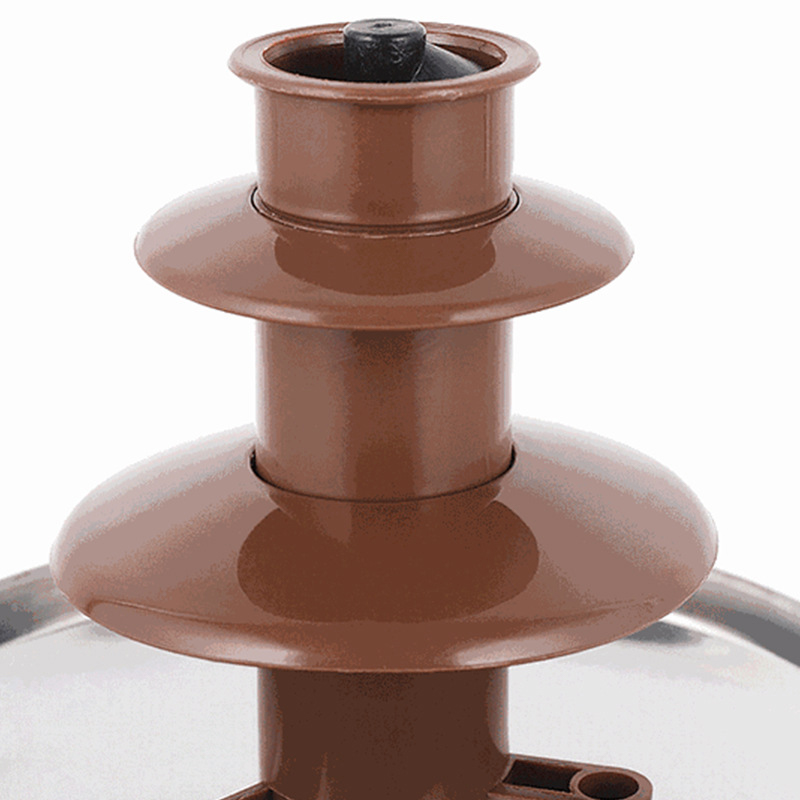 JK-110 Mini Chocolate Fountain with Lightweight PP ShellThis 150ML fountain uses a PP shell and PC viewing section with stainless steel pipes, offering an easy-to-clean, light option for those preferring plastic over a stainless steel bowl in small party sizes.View Product →
 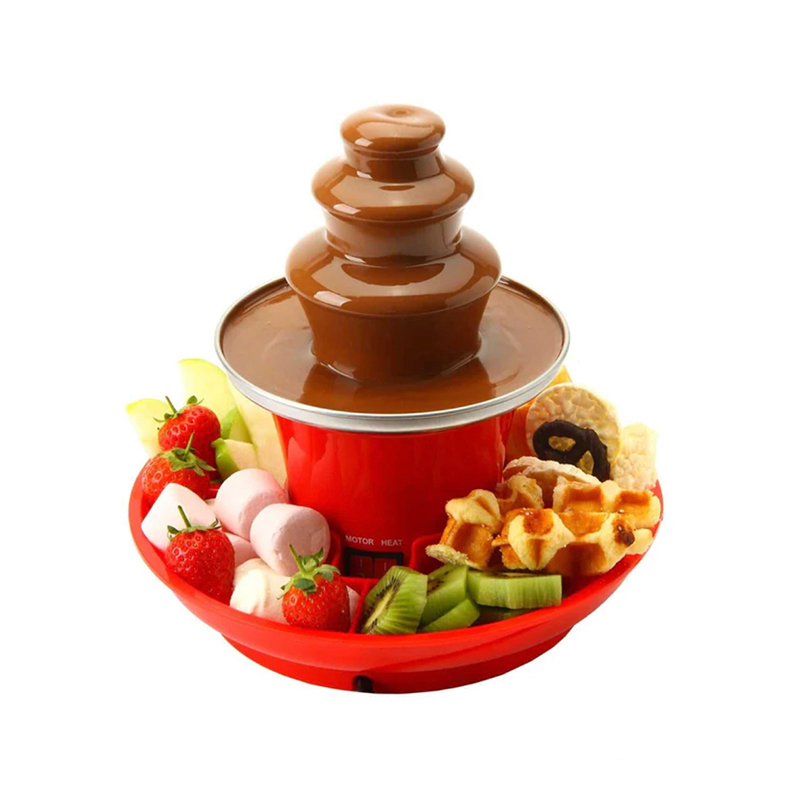 JK-111 Orange Stainless Steel Mini Chocolate FountainWith an orange stainless steel body, 150ML capacity, and 35W power at 220-240V, this model fits the article's stainless steel option that holds heat longer and polishes clean for home gatherings.View Product →
 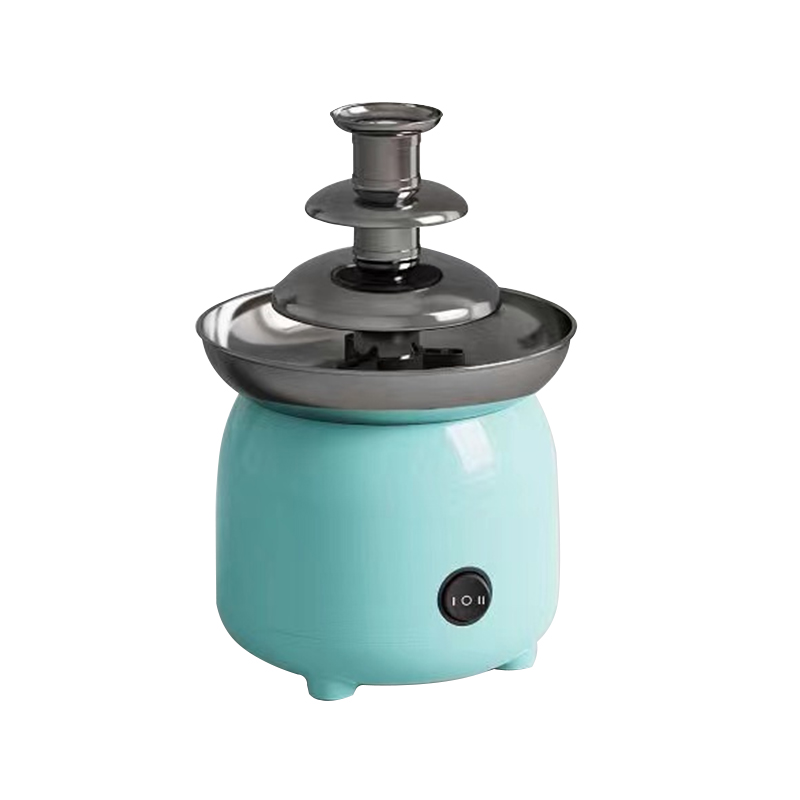 JK-Q120 65W Mini Chocolate FountainRunning on just 65 watts from any standard household outlet, this CE-certified 150ML fountain circulates chocolate smoothly for hours, with a 0.9m power cord adding placement flexibility.View Product →
The JK110 uses a PP shell for light handling, the JK111 pairs an orange stainless steel body with the classic tiered silhouette, and the JKQ120 runs on just 65 watts—low enough for any household outlet while still circulating chocolate for hours. All three follow the same auger-and-basin principle described above, which is why the setup and cleaning routine stays interchangeable across the range.
As a small-appliance factory established in 2010, we build and test these machines on our own production line and supply both retail buyers and distributors; you can browse our full range of home kitchen appliances at any time.
A chocolate fountain is, in the end, a heated loop: melt the chocolate thin, let the auger carry it up, let gravity lay it back down, and repeat. Respect the two variables the loop depends on—temperature and viscosity—and the curtain will run from the first guest to the last skewer. If you are weighing models for a shop, a rental business, or a family kitchen, our team can help match capacity, material, and plug type to your market.